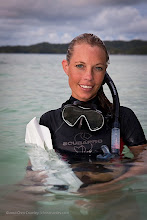
Showing posts with label sharks. Show all posts

Friday, October 3, 2008

Look Ma, No Tanks!

And… I am loving it!

Last year, I had the opportunity to meet Hanli Prinsloo – world class and champion freediver when I was diving with the white sharks. Watching her in the water made me realize she is true to her word. She really IS water. So graceful and free underwater on a single breath of air.


A few days later I did a photo shoot with Roger Horrocks freediving with tiger sharks. And while I managed, I certainly didn’t meet my own high expectations of my first freediving experience: to glide elegantly deep under the surface as seconds melt away into minutes. I found myself wishing I could dive deeper, stay down longer and improve my confidence without a nearby air source. But, I loved the freedom that not having a tank on my back allowed me to have.

And, I was even more enthralled to be able to experience the animals in a way I had never experienced before. It was like for the first time, I had truly entered their world. The sharks and I were interacting as if we were equals. Instead of swimming nervously away from me, or keeping their leery distance, they came right up to me immediately – even the tigers – to greet me. Without noisy tanks between us, I felt like I was accepted as one of them, and we were able to swim next to one another free of the barrier of fear that has kept us from truly connecting in the past (theirs of course.)


I became quickly addicted to the benefits of freediving and spent the next several days free of the confines dive gear imposes – one with the tigers. And, with the encouragement of my freediving buddy, the infamous Wolfgang Leander, a man who loves sharks almost as much as he loves freediving, I was hooked.


It was then I decided to become a shark. The first step? Ensuring I could enter their world on their terms. So, it was then I vowed to become a freediver.

I returned to the states and immediately ordered my gear and signed up for Hanli’s next class, in September in Aliwal run by my friends at Blue Wilderness, and their program "I am shark."

Finally the time had come. In two days, Hanli taught me more than I could have ever imagined about the sport of freediving, gave me the confidence and tools I needed to “live” underwater, and most importantly, reminded me of the strength we all have within to achieve everything we put our mind to – as long as we can harness it.

I learned breathholding techniques, proper eating pre and post diving, pre-diving yoga, how to breathe up, “stuffing” air into all my cavities, relaxation, the power of the mind, working through physical limitations and urges, and perserverence. I shocked myself to find that I can hold my breath for almost three minutes and on my first day of diving in the oceans, I dove to almost 60 feet with ease to pause at the bottom and listen to the whales sing. Not bad for a tank guzzler, huh Wolfie?

Hanli was an incredible teacher and I was totally hooked on freediving. It gives me confidence, freedom and an even, cenetered deameanor but more importantly, it gives me a window into the shark’s world.

Wednesday, August 27, 2008

Headed for disaster... without knowing it


Out of sight out of mind, as the saying goes. This is why so many people are surprised when I tell them that many shark species are almost extinct. And nearly all are headed for disaster.

But, you can’t stop something so terrible from happening if you don’t know about it. Or know why you should care.

Over 100,000,000 sharks were killed last year – primarily for their fins. Indeed, their populations are down to critical levels and they are still being fished out of the ocean at a completely unsustainable rate. In fact, recent studies indicate regional populations of sharks are down by 95 – 99%. That is considered functional extinction.


Many don’t know about this issue, because it happens so far away from us. Out in the oceans, far from shore, far from our eyes and far from governmental protection. We assume sharks are protected in marine reserves or that it is some other country’s problem. Many of us may even live in countries in which certain types of shark fishing is illegal – though most likely it is still occurring right under our noses.

And, it happens for reasons that many of us are not familiar with: it happens for the incredibly valuable shark fin. The key ingredient in a tasteless, social climbing soup. It is known as Fish Wing Soup in Asia and is so highly sought especially given its cultural association with health, prosperity and good fortune, it can sell for upwards of $100 a bowl. And while the supply is plummeting, the demand for shark fin soup is at an all time high.


Yes, the incredibly lucrative market for shark fins is driving the slaughter. And this industry full of greed and corruption is often likened to the illegal drug trade as it is rife with murder, mafia, and millions of dollars. Fisherman desperate to feed their families are being driven to extremes, and it is only a handful of individuals who are benefiting – at a incredible cost to all of us.

We have seen it before. All the factors are there for a global species extinction.

And once they know the fate facing sharks, many people throw up their hands and wonder why they should care, already convinced the only good shark is a dead shark after watching movies like Jaws and shows on Shark Week. Hasn't the media taught us that sharks are blood-thirsty, indiscriminant monsters with an insatiable hunger for human flesh? Should we really care if they disappear? Wouldn’t the world just be a better place?


Then comes the next surprise: contrary to all of the rubbish we have been taught, we are not on the sharks’ menus. In fact, of 6.5 billion people that live on this planet, only one died last year from a shark bite. One. Compare that to the amount of people who die from lightening strikes, car crashes, hunger, even falling coconuts and you realize there are many things to be worried about – but sharks are not one of them. Of the over 500 species of sharks, only a handful have ever even had encounters with humans. The truth? Sharks are magnificent creatures that are more scared of us than we could ever be of them.

If only we could let our fears go and realize sharks are misunderstood creatures that desperately need our help.

Maybe if we realized how brutal it is to fin a shark we might also care a bit more. Tragically, sharks are dragged while alive onto fishing boats where a knife with a hot blade is used to slice off all of the shark’s fins. Then, the shark is thrown back into the ocean still alive to bleed to death – or drown.


Maybe if we knew that while we collectively enjoy our shark steaks, shark fin soup, or shark cartlidge, that instead of being healthy we are actually poisoning ourselves, we might stop endlessly creating demand. Because sharks have levels of methyl-mercury in their flesh that is so high, a single shark steak can cause mercury poisoning, leading to sterility, nervous system issues and birth defects for those that consume it.

Or maybe if we realized that sharks keep our largest and most important ecosystem healthy – an ecosystem that provides us with much of the air we breath and food we eat – we might realize our existence, in part, is dependent on theirs. Sharks have sat atop the oceans’ food chain, keeping our seas healthy and balanced for 450 million years. Those oceans absorb most of the carbon dioxide that we put into the atmosphere, converting it into 70% of the oxygen we breathe. The oceans also supply us with a large percentage of the food we eat – including serving as feed for many farmed animals. Yes, all that life is kept healthy by sharks, who, as apex predators, regulate the oceans. Destroying shark populations is destroying our oceans - our very life support systems – and thus, ourselves.

We don't hear how the elimination of sharks might impact our best natural defense against global warming. Or how our favorite foods might disappear as a side effect of the extinction of sharks. Or that we could lose more oxygen than is produced by all the trees and jungles in the world combined if we lose our sharks.

So whether you are like us and you absolutely love sharks and cannot imagine an ocean without them, or you simply realize the loss of the sharks from this planet has huge, far-reaching implications that cannot be ignored, the time to act is now. We must work together, fight this war and save our sharks.

(Photos courtesy of Jeff Rotman.)

Monday, June 2, 2008

Chasing Sharks Towards Extinction

As shark populations plummet worldwide with many species rapidly facing extinction within the next two decades, Australia, a country often known for its environmental rigor, has made a shocking move. The Queensland, Australia government is legalizing shark fishing in the Great Barrier Reef.

A historical first, the Queensland, Australia government is creating a dedicated shark fishery in a World Heritage Area. The measures, which protect only 4 shark species, will allow fishing of 24 endangered or threatened species in critically vital and currently protected shark habitats. Additionally, the proposal offers no firm catch limit to the number of sharks that can be fished, foreshadowing a long-term population collapse of many species of sharks in the Great Barrier Reef – as well as the collapse of the reef ecosystem itself.

This new legislation could not have come at a worse time for sharks. Desired for their fins, estimates indicate over 100,000,000 sharks are killed each year and more than 90% of many regional shark species are almost extinct. Sharks are highly vulnerable to over-fishing and take decades to repopulate, if at all. No worldwide protection for sharks exist and even the few marine reserves that serve as sanctuaries such as Cocos and the Galapagos Islands have fallen prey to illegal shark fisheries. Sharkfinning is big business, driven by greed and a sky-rocketing demand for shark fin soup in Asia.

The disappearance of sharks from our world’s largest and most critical ecosystem is a frightening thought. Research has repeatedly proven sharks, as an apex predator, play a vital role keeping our oceans healthy and in balance. When sharks are removed or diminished in number, severe problems cascade down the highly interconnected food chain. Other species are pressured and often eliminated - species that are either important foods for humans or upon which the health of the reefs themselves is dependent. Without sharks, the oceans - our very life support system – may be destroyed.

Sadly, the threats facing sharks, a mal-aligned and misunderstood species, are largely unknown or ignored. The public’s general apathy or even disdain for sharks frequently leads to their demise.

At a time when many of the environmental challenges we face seem insurmountable, a hope exists for sharks: an immediate moratorium on shark fishing worldwide. Instead, the Australian government has chosen to move decades backwards, legalizing shark fishing in a delicate, already threatened ecosystem and one of the world’s most important marine protected areas. In doing so, Australia stands to lose its precious shark population, jeopardize its lucrative tourism industry, and forever tarnish its reputation as an environmental leader.

International pressure is needed to stop these measures. Australia must be urged to ban all shark fishing immediately throughout the entire Great Barrier Reef area, vigorously enforcing these policies. Instead of contributing to the issue, Australia should be encouraged to set a world-wide example, leading the fight to protect sharks, our oceans and our planet.

We simply cannot afford to lose one of the world’s most treasured ecosystems and one of the key species that keeps it healthy.

Nor can we afford to ruthlessly and unnecessarily kill one more shark.

Shark Savers is currently collecting signatures on a petition protesting these measures – www.sharksavers.org.

Tuesday, May 20, 2008

Shark vs. Man

I think the next time someone asks me why sharks, I am going to say “because I am hopelessly attracted to dangerous men, you know, the real bad boys – men who are absolutely awful for me. If a man is unavailable, far too confident for his own good, or a total player, rest assured this is the guy I want. So getting into the water with sharks is a much better option – keeping me away from the real predators…”

Wait, would that make me sound a little bitter?

In the last two days, I have received random SMS messages/calls from two different ex-boyfriends between the hours of 3 am and 4 am. I didn’t answer either, btw. Yes, I would chose sharks any day of the week. Way, way safer - and more considerate.

(Photo below by my friend Wolfgang Leander.)

Saturday, May 17, 2008

Becomming a Shark Angel


So, everyone always wants to know... why sharks?

I grew up in the water… I was the kid who was al
ways swimming in a lake, river or stream, eagerly peering to the bottom to have a chance encounter with some sort of marine life! I would catch guppies and put them in jars as my pets, obsessed with all things aquatic. I come from a long line of "mermaids" – some of my favorite childhood memories revolve around my grandfather and father spending an afternoon swimming in the lake near our house.

And, I have been obsessed with sharks since I was a kid. They have alwa
ys held a sense of magic for me. When I started diving, I remember the thrill of my first Black Tip Reef shark sighting. A dive wasn't a success unless I saw at least one shark! I have such an amazing appreciation and admiration for sharks, and I learned very, very early on that they were far more afraid of me than I was of them. Shark sightings were something to be cherished – not dreaded.

I have been diving with the Hammerheads in
Cocos, the Black Tips in Fiji, the Leopards in Thailand, the Tigers in the Bahamas, the Whites in South Africa and the Silver Tips in Tahiti. And in that time, I have sadly witnessed my cherished creatures disappear.

When I think about what is going on with sharks, I want to scream and run through the streets shaking everyone and telling them that we are letting one of our most precious resources slip through our fingertips. Such majestic, beautiful creatures don't deserve to be slaughtered –
especially for a pathetic, social climbing soup. And, their role in our most important ecosystem is of the utmost importance. The oceans' supply much of the food we eat and air we breathe. Sharks sit atop of that food chain and keep our oceans, our very life support systems, healthy. What would our world be like without sharks? I for one do not want to find out.

I have been a passionate and long time shark activist - and about a year and a half ago, realized that I had to d
o more. I came together with a group of five other people after organizing a campaign to Ban Sharkfin Soup in New York City. As divers, lovers of the environment, and admirers of the ocean, we had personally witnessed the devastation of everything we hold sacred – including our precious sharks. And, when we wanted to do something, we realized that it wasn't as easy as it should be. Learning about sharks, educating others, developing tools to build awareness and choosing the right things to focus on in order to make a difference were all cumbersome and challenging. And, there was no clear, globalized movement to join. We thought there should be. And thus, Shark Savers was born. I am now the Director of Strategy & Outreach for Shark Savers. Much of what I do involves using my marketing and PR skills towards a positive image campaign for sharks while speaking on their behalf at events, schools, and even charitable events. I also do a considerable amount of education and of course, development.

Realizing the importance media plays in influencing our collective mindset, I have also become heavily involved in productions that involve sharks - in a positive light. A year ago, I began spearheading marketing and PR initiatives for the movie, Sharkwater. I worked closely with Rob Stewart to roll the movie out here in the states, build awareness and garner support – as Sharkwater is one of the best conservation tools we have. I now work in marketing & development in a broader role for the production company as well.

And, six months ago, I still wanted to do more. After meeting Kim McCoy from Sea Shepherd and Alison Kock from Save Our Seas, Shark Angels was born. Shark Angels is a movement that is being kicked off by a documentary about three female shark conservationist
s, a scientist, an activist, and an enforcer, partnering together to show people the truth about sharks – that they are not ruthless maneaters, but instead magnificent creatures to be protected – and cherished. In the production, I played the role of writer, co-producer, and of course, Shark Angel. The documentary is in post-production and is set to launch in the Summer of 2008. More than anything else, we want to unite the public around a new view of sharks – and bring attention to their plight.

I am motivated at the core by a passion to save sharks - and try to stay away from the drama and politics that sometimes surrounds that. I truly believe that there is so much strength in working together - and if we can't come together, strengthen our approach, and work together to combat this madness, we could lose our sharks, and soon after that, our oceans. I desperately want everyone to be aware of this situation – to join the fight. I have now essentially committed my every waking moment of passion to efforts that fuel that goal… I have no idea how this will manifest itself, but I have finally decided to follow my passion, in the hopes that great things will happen and I may save a few sharks...